

The Asia Pacific Hospice Palliative Care Network (APHN) and the Philippine Department of Health (DOH), together with Hospice Philippines and key national stakeholders, have reaffirmed their partnership through the signing of a Joint Statement of Commitment to advance national faculty development for palliative and hospice care over the next three years.
This milestone marks a significant step in strengthening the Philippines’ palliative and hospice care system, rooted in trust, a shared vision, and more than a decade of collaboration between APHN, the DOH, and the country’s professional bodies.
A Partnership Built on Continuity and Shared Purpose
APHN’s collaboration with the Philippines has evolved steadily—from early scoping and readiness assessments, to leadership and training support for national manuals, and now to a structured and sustainable National Faculty Development Programme.
Over the years, APHN has worked closely with DOH offices, Hospice Philippines, the Philippine Society of Hospice and Palliative Medicine (PSHPM), and academic and service institutions to strengthen clinical competence, teaching capacity, and system integration nationwide.
This enduring partnership reflects a shared commitment to Universal Health Care (UHC) and aligns closely with DOH Memorandum 2023-0094, which calls for a shift from disease-based programmes towards integrated, primary-care-oriented service delivery. It also complements the DOH Manual of Operations for Palliative and Hospice Care, as well as the evolving PhilHealth palliative care benefit package.
Developing a National Cadre of Faculty and Mentors
At the heart of this collaboration is the Palliative and Hospice Care (PHC) National Faculty Development Programme, designed to build a sustainable pool of national faculty who will serve as mentors and lead trainers across the Philippine health system.
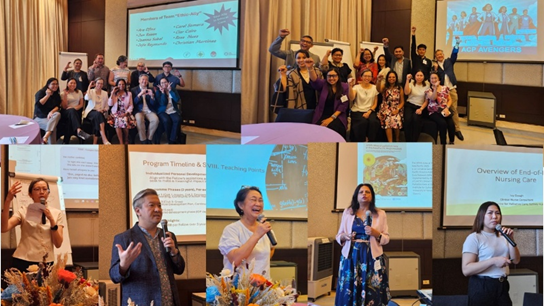
The programme brings together experienced clinicians, educators, and contributors to DOH training manuals—many of whom have already completed intensive national training—to further develop advanced clinical expertise and teaching leadership. The structured curriculum spans complex pain and symptom management, end-of-life care, interdisciplinary teamwork, advance care planning, and ethical and legal decision-making, while emphasising adult learning principles, reflective practice, and mentorship.
Beyond clinical mastery, participants are prepared to cascade training through Centers for Health Development (CHDs), local government units (LGUs), hospitals, and community-based providers, ensuring consistency and quality as palliative and hospice care is scaled up nationwide.
From Training to System Strengthening
The National Faculty Development Programme represents the implementation phase of a longer national journey. Between 2023 and 2024, APHN supported foundational activities that laid the groundwork for this initiative, including national scoping assessments, leadership development, and early faculty engagement.
These efforts have now matured into a formalised national framework for mentorship, quality assurance, and programme development. The programme also serves as a bridge between national priorities and global best practices, with APHN providing international faculty input, comparative perspectives from other low- and middle-income countries, and ongoing mentorship to ensure relevance, rigour, and sustainability.
A Three-Year Joint Commitment for the Future
Through the Joint Statement of Commitment, partners have agreed to a shared set of priorities over the next three years:
- Strengthen and sustain a national faculty pool of mentors and lead trainers
- Support quality assurance and programme development in palliative and hospice care
- Expand access to high-quality palliative care across cancer and non-cancer conditions
- Prepare national faculty for advanced regional and international leadership roles
This commitment signals that faculty development is not a one-off intervention, but a long-term investment in people, systems, and compassionate care.
An Invitation to Build Together
As APHN and the DOH move forward together, this collaboration stands as an open invitation to national faculty, institutions, and partners to play an active role in shaping the future of palliative and hospice care in the Philippines.
By strengthening educators, mentors, and leaders, the partnership aims to ensure that every Filipino—regardless of geography or diagnosis—has access to timely, dignified, and person-centred palliative care.
Together, APHN and the Philippines demonstrate how long-standing regional collaboration can translate into national impact—today and for generations to come.
The National Faculty Development Programme is part of the Lien Collaborative for Palliative Care initiative. Lead APHN faculty include Professor Ghauri Aggarwal (Australia) and Professor Patricia Neo (Singapore).
Written by Mr Giam Cheong Leong (APHN Executive Director )
This project is a Lien Collaborative for Palliative Care initiative to build capacity in developing countries in Asia. The Lien Collaborative for Palliative Care was co-developed by the Asia Pacific Hospice Palliative Care Network (APHN) and the Lien Foundation.