
Written By Navin Francis Susinadan, Palliative Care Unit (PCU), Malacca Hospital
The Weight of the Corridor
In a bustling public hospital ward, the reality of palliative care is rarely about grand technological breakthroughs; it is lived in the quiet, heavy spaces between beds. As a palliative care consultant physician at Malacca Hospital in Malaysia, I stand daily beside patients from lower-income families struggling with advanced illness, trying to coordinate home nursing, symptom tracking, and family support with whatever resources are at hand.
Often in the public healthcare systems, clinicians find themselves caught between two worlds: an overwhelming clinical need to track longitudinal symptom trajectories, and the rigid, bureaucratic walls of software procurement. Across the Malaysian digital software industry, commercial agencies quote between RM 50,000 and RM 150,000 (~USD 11,000 to $33,000) for basic departmental dashboards, while enterprise-grade clinical monitoring systems or electronic medical registries with data compliance routinely cost between RM 150,000 and over RM 300,000 (~USD 33,000 to $66,000+) for an initial deployment [1, 2]. Compounding this, standard local software engineering benchmarks dictate that annual maintenance, server hosting, security patches, and operating system updates consume 15% to 25% of the original build cost each year [1, 3]—adding a recurring liability of RM 22,000 to RM 60,000+ (~USD 5,000 to $13,000+) annually.
Furthermore, under statutory Malaysian Treasury regulations, any government ICT procurement exceeding RM 50,000 cannot be handled via direct purchase; it mandates formal quotation tenders, agency quotation committee approvals, and review by ministerial ICT technical committees [4]. For public hospital teams operating on constrained operational budgets, these procedural hurdles mean that commissioning bespoke software often involves multi-year procurement cycles and months of waiting for external vendors to understand what a palliative clinician actually needs at 2:00 AM.
Finding a Key in Our Own Pocket
The turning point came not from a massive tech grant, but from looking closer at what was already in our hands. Through the Ministry of Health Malaysia, we already had access to an enterprise Google Workspace infrastructure [5]. Instead of waiting for a bespoke software budget that would likely never arrive, we asked a simple question: What if we built it ourselves?
With zero formal coding experience, armed only with clinical intuition and standard tools like Google Sheets, Apps Script, Gemini AI, and Google Sites, we set out to bridge the gap. Within days, rather than years, we built secure, functioning data entry portals with built-in de-identifiers, patient registries, symptom trackers, and referral pathways tailored specifically to the workflow demands of the hospital.
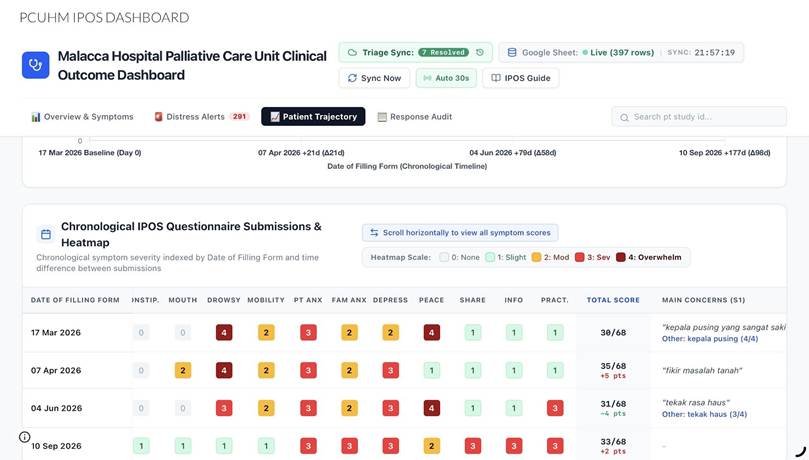
The resulting Malacca Hospital Palliative Care Unit Clinical Outcome Dashboard operates entirely within this government-provisioned cloud ecosystem (as illustrated in Figure 1, capturing live Google Sheet data feeds with synchronized triage metrics). Because everything lives within secure enterprise boundaries, patient confidentiality and data governance are protected natively under Malaysian public sector data security frameworks without needing complex third-party security audits or expensive licenses [5, 6].
Bringing High-End Care to the Bedside
The true impact of this shift isn’t measured in abstract lines of code; it is measured in how we capture and respond to patient distress over time.
By leveraging native spreadsheet logic and cloud scripting, the dashboard transforms raw questionnaire inputs into actionable clinical insights:
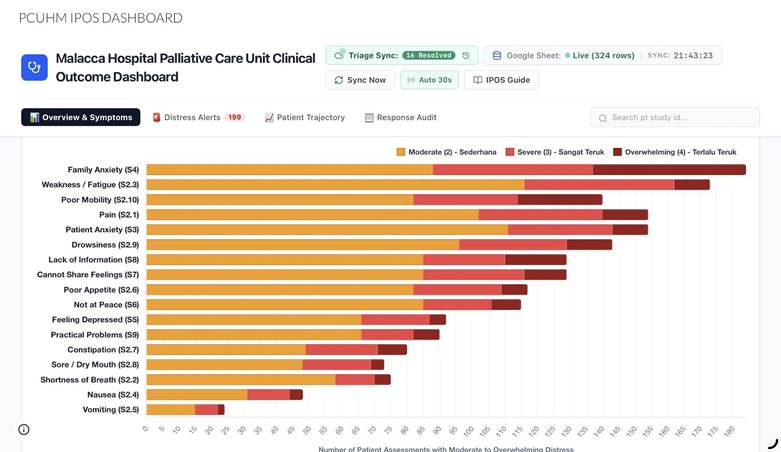
- Visualizing Aggregate Burden: Department-wide analytics (as shown in Figure 2) instantly aggregate symptom prevalence—ranging from pain and fatigue to psychological and family anxiety—allowing our team to allocate clinical resources where the community needs them most.
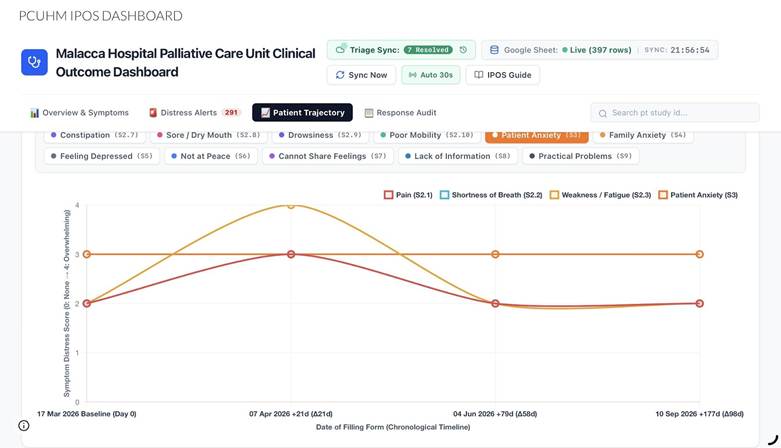
- Tracking Longitudinal Trajectories: Individual patient tracking (demonstrated in Figures 3 and 4) maps symptom changes across visits, enabling clinicians to visualize specific symptom flare-ups (such as persistent constipation or pain spikes) over extended timelines.
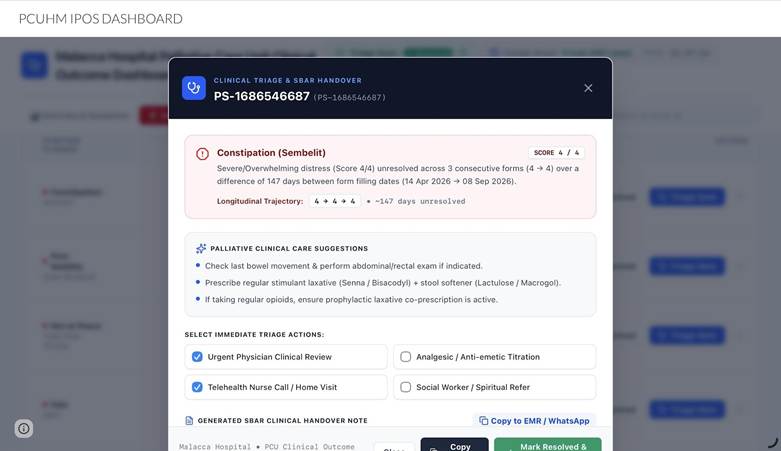
- Automated Clinical Triage & SBAR Handovers: Built-in alert mechanisms flag unresolved severe distress (score 4/4 across consecutive visits), instantly generating automated SBAR (Situation, Background, Assessment, Recommendation) handover notes and suggested clinical care pathways (as seen in Figure 3).
When a clinical team can instantly deploy a digital data-entry protocol or an integrated referral dashboard without vendor delays, everything changes:
- The Clinician is Empowered: We are no longer passive consumers waiting for software updates. We can adapt our digital tools in real-time as clinical guidelines evolve, translating frameworks like the REMAP model or symptom scales directly into daily workflows.
- The Financial Barrier Vanishes: By bypassing commercial developer fees and the perpetual 15%–25% annual maintenance overhang [1, 3], every ringgit saved stays where it belongs, focused on direct bedside patient care.
- Equity in Action: Most importantly, patients in public hospitals, who so often belong to the lower socioeconomic tiers, now directly benefit from high-end, data-driven tracking, rigorous quality audits, and seamless multidisciplinary coordination. High-standard digital health is no longer a privilege reserved for the wealthy; it belongs to anyone who walks through our public ward doors.
A Call to Fellow Clinicians: Take Back the Blueprint
Our experience within the Malaysian public healthcare system demonstrates that innovation doesn’t always require a Silicon Valley budget. Sometimes, it simply requires trusting clinicians to solve their own problems using the secure tools already at their disposal.
For international networks, palliative care advocates, and healthcare systems worldwide, this is an invitation to look past the illusion that digital health must be expensive or complex. By empowering clinicians to build their own bridges, we can strip away unnecessary overhead, eliminate vendor dependency, and place the future of compassionate, equitable care right back where it belongs: in the hands of those at the bedside.
References & Industry Benchmarks
- Malaysian Software Development Cost & Healthcare Standards: ZoomoTech & Gotchaa Lab Industry Pricing Guides (2024–2026). Custom Software & Mobile App Development Cost in Malaysia.
- Clinical Registries & Digital Health Economics: Agency for Healthcare Research and Quality (AHRQ). Registries for Evaluating Patient Outcomes: A User’s Guide. 4th edition. Rockville (MD): AHRQ; 2020.
- Software Maintenance Lifecycle Rule of Thumb: Pressman, R. S., & Maxim, B. R. Software Engineering: A Practitioner’s Approach. McGraw-Hill Education; IEEE Computer Society Standards on Software Life Cycle Processes (IEEE/ISO/IEC 12207).
- Malaysian Treasury ICT Procurement Regulations: Ministry of Finance Malaysia (MOF). Pekeliling Perbendaharaan Malaysia PK 2.1 (Kaedah Perolehan Kerajaan) & MAMPU Guidelines on ICT Project Procurement
- Malaysian Public Sector ICT & Cloud Infrastructure: Malaysian Administrative Modernisation and Management Planning Unit (MAMPU) / Ministry of Health Malaysia (KKM). Public Sector Cloud Computing Framework & MyGovUC Enterprise Collaboration Services.
- Data Protection & Healthcare Confidentiality: Laws of Malaysia. Personal Data Protection Act 2010 (Act 709) and Ministry of Health Malaysia ICT Security Policy (DKICT KKM).
- Integrated Palliative care Outcome Scale (IPOS): Murtagh, F. E., Ramsenthaler, C., Firth, A., et al. (2019). A brief, patient- and proxy-reported outcome measure in advanced illness: Validity, reliability and acceptability of the Integrated Palliative care Outcome Scale (IPOS). Palliative Medicine, 33(8), 1045–1057. Cicely Saunders Institute, King’s College London (https://pos-pal.org).
- SBAR Clinical Communication Framework: Institute for Healthcare Improvement (IHI). SBAR Tool: Situation-Background-Assessment-Recommendation. Cambridge, MA: Institute for Healthcare Improvement; 2021.

